Pre-Construction Appraisal Gap in 2026: Every Option Canadian Buyers Actually Have
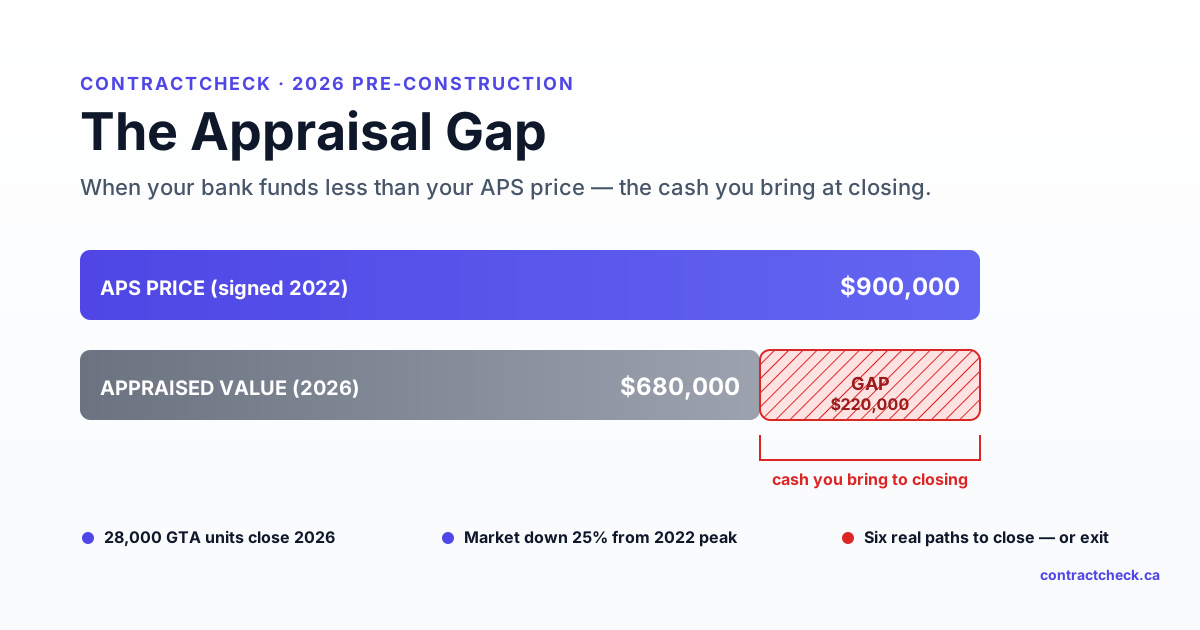
TL;DR — Appraisal gap on a 2026 pre-construction closing
- Lenders fund the lower of appraised value or APS price. If the unit appraises below the APS, you bring the difference in cash.
- Typical 2026 Toronto gap: $150K–$300K on a condo signed at the 2021–2022 peak.
- Six realistic paths: bridge with private capital, co-signer, vendor take-back, assignment at a discount, mutual release, or termination for builder breach.
- Walking away with no legal grounds exposes you to a lawsuit. In Mattamy (Jock River) Ltd. v. Ishola, 2024 ONSC 6231, the court ordered $87,714.49 in damages plus interest on top of a forfeited deposit — the builder can keep your deposit and recover the resale shortfall.
- Start 90+ days before closing. Order your own appraisal. Surface any builder breach before closing day.
If your Toronto or Vancouver pre-construction condo is closing in 2026 and your appraisal came in $150,000 below your Agreement of Purchase and Sale price, you're not alone. Per Urbanation, roughly 22,000 GTA pre-construction condo units are projected to complete in 2026 — the tail end of a record wave (2025 saw ~29,000 completions). Most of these were sold at the 2021–2022 peak and are now appraising well below their APS price.
This is the appraisal-gap playbook Canadian buyers actually use to close (or exit) in 2026. Every option has a real cost, a real timeline, and a specific clause in your APS that enables or blocks it. The version of this guide you want depends on which side of the gap you're on.
New as of April 1, 2026 — Ontario freehold Tarion registration
Ontario freehold pre-construction buyers should register their APS with Tarion's online purchase-registration portal within 45 days of signing. Registration is free.
Starting January 1, 2027, buyers who fail to register within the 45-day window may have their deposit coverage paid from a separate industry fund capped at $15 million per year, rather than Tarion's full guarantee fund — potentially reducing payouts.
This rule applies to freehold only. Condo deposit protection under Condominium Act s.81 trust is unaffected. See Tarion's announcement.
What an appraisal gap actually is
A mortgage lender funds the lower of two numbers:
- The purchase price in your APS, or
- The appraised value on closing day.
If the appraisal comes in below the APS, the difference — the "appraisal gap" — is what you must bring to closing in cash, on top of your original downpayment and closing costs.
Example:
- APS signed in 2022: $900,000
- Deposit paid over 2022–2025: $180,000 (20%)
- 2026 appraised value: $680,000
- Lender's maximum mortgage (80% of $680K): $544,000
- Cash needed at closing: $900,000 − $180,000 deposit − $544,000 mortgage = $176,000 gap
- Plus closing costs (land transfer tax, legal, HST adjustments): ~$40,000
- Total cash needed at closing: ~$216,000
For most buyers who qualified for a mortgage in 2022, that $216K is not sitting in a savings account. That is the gap.
Why 2026 is the worst year for this
Three forces are compressing at exactly the wrong moment for Canadian pre-construction buyers:
- Price decline: Toronto condo prices are down ~25% from the 2022 peak per CBC and Urbanation. Vancouver pre-sale prices are down 15–20% since 2022.
- Rate shock: The 2.5% 5-year fixed mortgage you modeled in 2022 is now a 5.0–5.5% mortgage. Even if the appraisal funds, your monthly carrying costs are 30–50% higher than projected.
- Stress-test tightening: OSFI's B-20 stress test means you must qualify at ~7% even on a 5% mortgage. Many 2022 buyers who qualified for a $700K mortgage at 2.5% no longer qualify at 7%.
The result: dual squeeze. Your unit is worth less, and you can borrow less against it. Both problems arrive on the same day — closing day.
Option 1 — Bridge the gap with private or B-lender capital
If your A-lender approves a mortgage up to the appraised value, you still need to fund the shortfall. The realistic bridge sources, in descending order of cost:
| Source | Typical rate | Term | Best for |
|---|---|---|---|
| HELOC on existing property | Prime + 0.5–1.5% | Revolving | Buyers with real equity in a primary residence |
| Documented family gift | 0% | N/A | Buyers with a parent who can gift; requires CRA-compliant paperwork for the lender |
| B-lender second mortgage | 7–10% | 1–2 yr | Strong income, weak cash position |
| Private second mortgage | 10–13% | 1 yr | Last-resort bridge while repositioning refi |
| Vendor take-back from builder | 4–7% | 2–5 yr | Rare, but builders are quietly offering these in 2026 to preserve closings |
The vendor take-back (VTB) mortgage is the underappreciated 2026 option. Builders facing mass walk-aways would rather hold paper at 6% for 3 years than litigate 200 buyers under Ishola. Ask. The worst they can say is no.
Option 2 — Add a co-signer or guarantor
A strong-income co-signer (parent, sibling, spouse) can push the mortgage approval above what you qualify for alone. This doesn't solve the appraisal gap directly — the lender still funds the lower of price/appraisal — but it can increase the mortgage amount against the appraised value to the full 80% LTV, reducing the cash you need.
Co-signer risks are serious. The co-signer is on the title and the mortgage. If you default, the lender goes after them first. Have the conversation explicitly before closing.
Option 3 — Assign at a market-clearing price
If your APS allows assignments (most GTA pre-cons do, with builder consent and a $5K–$25K fee), you can transfer your contract to a new buyer before closing. They close directly with the builder; you exit.
In a falling market, expect to price the assignment below your original APS. The new buyer is essentially buying at today's market value — and the loss comes out of your deposit. But a partial deposit loss is dramatically better than forfeit + Ishola damages.
Example:
- Your APS price: $900,000
- Current market value: $680,000
- You assign at $710,000 (slight premium for the assignment structure)
- Assignee pays builder: $900,000 (at closing)
- You receive from assignee: $710,000 − $180,000 deposit credit = $530,000 loss absorbed by you via deposit forfeit + top-up
- Net outcome: you lose $190,000 up front, but you avoid a builder damages action for the resale shortfall plus carrying costs and legal fees on top of a forfeited deposit.
See our assignment clause guide for builder fees, HST treatment, and the 2022 CRA rule (profit on assignments = taxable business income, not a capital gain) that catches assigners off-guard.
Option 4 — Negotiate a mutual release with partial deposit retention
The economic math for the builder in 2026 has shifted. Rather than chase 200 underwater buyers through court for 3 years, many builders are accepting partial-forfeiture mutual releases. Realistic structures we've seen:
- Builder keeps 50–75% of deposit; buyer walks clean. Works when builder can resell at a modest further discount.
- Builder keeps 100% of deposit; both sides release all claims. Works when the project is 80%+ sold.
- Builder offers a project-wide deposit credit allowing buyers to swap into an unsold unit in a later phase at today's price. Specific to large multi-phase builders (Mattamy, Tridel, Minto).
The leverage point: mention Ishola back at them. It cuts both ways. Court costs and time apply to both sides, and no builder wants to be the next test case on a losing buyer-breach defence. Our mutual release playbook walks through the specific demand-letter language that has worked in 2024–2026.
Option 5 — Terminate for builder breach (the cleanest exit, if it's available)
A significant minority of 2022-vintage pre-cons have also seen the builder make material amendments, miss disclosure deadlines, or push the occupancy date past the firm final outside date. Any one of these can be grounds to lawfully terminate the APS and recover your full deposit.
Common 2026-era builder breaches:
- Material amendments to the disclosure statement (changes to fees, amenities, building design) without a proper 10-day re-rescission notice under section 74 of the Ontario Condominium Act.
- Outside occupancy date exceeded — this is mandatory grounds for termination plus Tarion delayed-occupancy compensation.
- Finishes or features substituted below APS spec — cheaper countertops, removed amenities, reduced square footage, balcony changes.
- Late or missing Tarion-required notices at occupancy and closing milestones.
- Occupancy fee miscalculations — the "phantom rent" builders charge during interim occupancy is rule-bound, and errors are recoverable.
Identifying a breach requires cross-referencing the full APS, disclosure statement, every amendment, Tarion Statement of Critical Dates, and all builder correspondence. This is exactly what ContractCheck is built for — most buyers assume there is no exit because they never do this analysis. In 2026, the analysis pays for itself many times over.
Option 6 — Walk away, and prepare for an Ishola-style lawsuit
If you walk with no legal grounds, the builder's options under Canadian contract law are:
- Keep the entire deposit.
- Resell the unit to a new buyer.
- Sue you for the difference between your APS price and the resale price, plus carrying costs and legal fees.
This is no longer theoretical. In Mattamy (Jock River) Ltd. v. Ishola, 2024 ONSC 6231, an Ontario buyer who failed to close on a freehold pre-construction APS was ordered to pay $87,714.49 in damages plus pre- and post-judgment interest after a credit for the $14,000 deposit paid. The principle — builder keeps deposit and recovers resale shortfall plus carrying costs — is settled. The exposure on a 2022-peak contract is typically much larger than the deposit alone.
Walking is sometimes the rational move — if the alternative is a $250K cash gap you genuinely don't have, and if the eventual resale loss + carrying costs + legal costs net out less than closing plus losing the unit in foreclosure a year later. But it should never be done without a real estate litigator's input, and never without first running options 1–5.
The 90-day checklist
The buyers who navigate 2026 cleanest start the process 90+ days before closing — not 7 days. Here's the sequence:
- Day 90 — Confirm your actual closing date in writing with the builder's lawyer. Not the projected date on the APS; the firm date with all extensions applied.
- Day 85 — Order your own appraisal through a mortgage broker. Don't wait for the lender's appraisal 30 days before closing. You need to know the gap now.
- Day 80 — Run the full math: APS price + closing costs + interim fees − available cash − max mortgage = your gap.
- Day 75 — Get a full contract review. Surface any builder-breach grounds. ContractCheck does this against Tarion rules, the Condominium Act, and current Canadian case law in 15 minutes.
- Day 70 — Talk to a mortgage broker about bridge and co-signer options. Not your bank branch — a broker who can shop B-lenders.
- Day 60 — Talk to a real estate litigator (1-hour consult). Not the one the builder recommended. Clarify your exposure under Ishola and any breach defences.
- Day 45 — Decide path: bridge, assign, mutual release, breach termination, or walk.
- Day 30 — Execute. If assigning, list now. If terminating for breach, serve notice. If closing, lock in your bridge financing.
Related reading
- Can't Close on Your Pre-Construction Condo in 2026? Your Six Options — the decision tree for all six paths.
- The Ishola Decision: What Ontario Buyers Owe When They Walk From a Pre-Construction APS — the case law every 2026 buyer should understand before walking.
- Mutual Release: What to Do When a Builder Refuses to Let You Walk Away — leverage tactics and demand-letter templates.
- Assignment Clauses in Pre-Construction — how to sell your contract before closing, builder fees, CRA tax trap.
- Pre-Construction Deposit Refund Rules — when you're legally entitled to your money back.
Get your specific contract reviewed
Which of the six options actually applies to you depends on the specific clauses in your APS, the amendments you've received, the Tarion Statement of Critical Dates, and any missed builder deadlines. Without that analysis, you're guessing.
ContractCheck runs a full AI review of your pre-construction package — APS, schedules, disclosure statement, every amendment — against Tarion rules, the Condominium Act, and current Canadian case law including Ishola and its 2025 progeny. Same-day analysis. Less than the cost of one hour of a real estate lawyer's time.
This article provides general information for Canadian pre-construction buyers and is not legal or financial advice. Appraisal-gap and closing disputes are fact-specific. If you are facing an imminent closing you cannot fund, consult a licensed real estate lawyer and a mortgage broker in your province.