Commission & Tax Implications — What Canadian Realtors Need to Know About Partner Income
Partner-program commission income feels like a small stream compared to your main brokerage commissions, so most agents don't think about the tax side until their accountant asks. That's usually fine — but there are two Canada-specific rules that trip up new partners every year, and both are easy to get right if you know them before you file.
This is a plain-English walkthrough of how ContractCheck partner commissions are treated under Canadian tax law, what slip reporting looks like, what expenses you can claim against this income, and when you need to think about HST. Not tax advice — talk to your accountant for your specific situation — but enough to ask the right questions.
The $500 T4A threshold
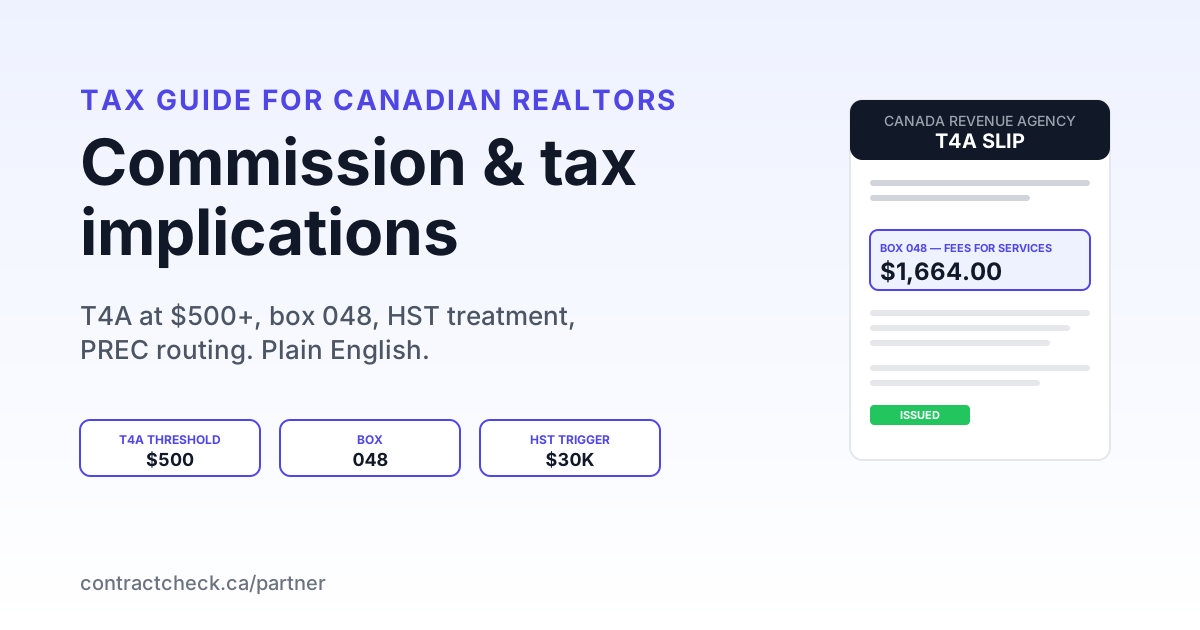
ContractCheck issues a T4A slip to any partner who receives $500 or more in commission payouts in a calendar year (January 1 to December 31). The slip lands in your email and CRA inbox in February or early March for the prior year. The amount appears in box 048 (fees for services).
Under $500 for the year, no T4A is issued — but the income is still taxable and must be reported. You'd include it as self-employment / "other income from services" on your return. Missing it isn't a "small error" — the CRA matches T4A-type income against your return automatically, and unreported amounts generate review letters.
The threshold is per-partner, not per-buyer. It's the sum of every commission you were paid in the calendar year.
How this stacks with your brokerage commissions
Your brokerage commissions show up on a T4A box 048 as well (or sometimes as a T5018 for construction-related sub-contracts). A ContractCheck T4A is a separate slip from the same income category. Your accountant will typically combine them onto a single T2125 (Statement of Business or Professional Activities) under your existing real estate business activity, or under a separate line if you prefer to track partner income distinctly.
There's no tax-rate penalty for having multiple T4A slips. They all flow into the same self-employment income bucket on your return.
Expenses you can usually net against partner income
Because partner commissions are self-employment income, ordinary business expenses that already relate to your real estate practice can be partially allocated against this stream. Typical examples:
- Phone and internet: the business-use percentage you already claim.
- Home office: square-footage percentage of rent / utilities / insurance if you already claim it.
- Marketing and tools: anything directly tied to driving referrals — e.g. paid social spend on a realtor landing page, email marketing software, business-card printing.
- Partner subscription ($199/month): directly deductible as a software / professional-tools expense. If you're a founding partner on a lifetime comp, there's no subscription cost to deduct, but commissions are still taxable.
For most agents, the partner commission income is small enough that expense allocation is handled inside your existing T2125 for the broader real estate business. You don't usually need a separate GIFI schedule.
HST on commission income
Real estate commissions in Canada are generally HST-taxable services. ContractCheck partner commissions are treated the same way. Whether you charge HST on top depends on your own HST registration status:
- If you're HST-registered (most full-time agents are, because the $30K/4-quarter Small Supplier threshold kicks in quickly), you must charge HST on your commission income. ContractCheck's payout amount is treated as tax-inclusive, and you remit the HST portion with your regular HST return.
- If you're not HST-registered (part-time, side practice under $30K), you don't charge HST, and you don't remit it. Just report the gross amount as income.
If you cross the $30K threshold mid-year, you're required to register and start charging HST from that point forward. Your accountant tracks this — but partner commissions count toward the threshold, so if you're close to it, flag the new income stream early.
Incorporated vs. sole-proprietor agents
Most Ontario agents operate as sole proprietors in their first few years and incorporate later via a Personal Real Estate Corporation (PREC). For PREC holders:
- Partner commissions flow through your PREC the same way any other commission does.
- The T4A will be issued to you personally if you signed up with your personal SIN on Stripe Connect. If you signed up with your corporate business number, the T4A is issued to the corporation.
- Either way, the income is reportable. The difference is just which return it appears on — your T1 personal return or your PREC's T2 corporate return.
If you're planning to incorporate soon and want partner commissions to route to your PREC from Day 1, sign up with your corporate Business Number on Stripe Connect during onboarding. Changing it later requires reopening the Connect account and can create a reporting mismatch across tax years.
The $500 edge case — and why most agents cross it faster than they think
A single active Pro-plan buyer ($39.60/month) crosses the $500 threshold at about 13 months. Two active Pro buyers at the same time cross it in 7 months. One Crisis-plan buyer ($59.60/month) crosses it in 9 months.
For a mid-volume pre-construction agent, the T4A is essentially guaranteed after the first year. Plan on it. Keep your Stripe Connect contact details current so the slip reaches you on time.
What to tell your accountant, in one email
"I've added a new income stream — referral commissions from ContractCheck, a Canadian contract-review SaaS. They pay 40% recurring on buyer subscriptions and issue a T4A if I earn $500+ in a year (box 048). It's paid via Stripe Connect to [personal SIN / my PREC business number]. I'm HST-registered / not registered. Let me know if you want me to allocate a portion of phone/home-office against this stream or bucket it with my main real estate business."
That's it. One email, one decision per line. Your accountant will take it from there.
The bottom line
Partner commission income is treated like any other self-employment income in Canada — ordinary tax, deductible expenses, HST if you're registered, T4A slip at $500+. There's no special treatment, no surprise tax, and no reason to over-engineer the tracking. Just make sure it gets reported, and talk to your accountant once before filing the first year so the stream is correctly categorized from the start.